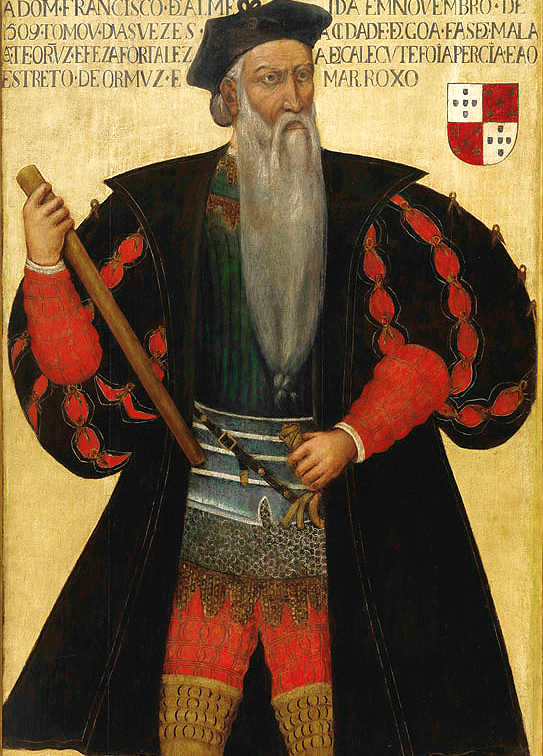
The story of the “Portuguese Fort” on Qeshm Island is historically linked to a prominent name in the history of Portuguese navigation: Afonso de Albuquerque. This ambitious leader realized at the beginning of the 15 th century that any power that could control three strategic points in the world—the Strait of Hormuz in the Arabian Gulf, the Gulf of Aden at the entrance to the Red Sea, and the Strait of Malacca in Southeast Asia—would control global trade routes. Based on this vision, he turned his attention to the waters of southern Iran, occupying Hormuz Island and then Qeshm Island in 1514.
The title may seem somewhat strange, but geographically it is realistic and logical. Portugal in the 15th century understood the importance of international shipping lanes and worked to establish a military presence capable of protecting and securing these routes.
This is evident from the remnants that still bear witness to the Portuguese presence on the coasts overlooking many of these vital maritime passages, whose importance the world now recognizes and whose powerful impact on the course of the international economy is keenly felt. Among the most important of these passages is the Strait of Hormuz, through which 20% of the world’s energy supplies pass.
The current discussion about the possibility of America sending Marines to protect energy supply lines in the Strait of Hormuz necessitates, first and foremost, understanding the geographical nature of this strait and the locations of the islands that extend along its coasts.
Among the most important of these is Qeshm Island, an island with a long military history, as the Portuguese were based there. On its land, they built what is known as the “Portuguese Fort” in the 15th century, one of the most important and massive military fortresses. The Iranian regime now exploits it as a protected base for suicide drones, which threaten navigation in the Strait, making it a bargaining chip in Tehran’s hands. Just as the sands of Iraq and the mountains of Afghanistan played a significant role in the lack of a decisive military victory, and even in the emergence and protection of many terrorist groups and organizations that exploited the difficult geography of those countries to hide and shield themselves from American forces for a time, history is repeating itself in the terrain of the Strait of Hormuz.
The story of the “Portuguese Fort” on Qeshm Island is historically linked to a prominent name in the history of Portuguese navigation: Afonso de Albuquerque.
This ambitious leader realized at the beginning of the 15 th century that any power that could control three strategic points in the world—the Strait of Hormuz in the Arabian Gulf, the Gulf of Aden at the entrance to the Red Sea, and the Strait of Malacca in Southeast Asia—would control global trade routes. Based on this vision, he turned his attention to the waters of southern Iran, occupying Hormuz Island and then Qeshm Island in 1514.
Operationally, the geographical nature of the Strait of Hormuz coastline makes land-based military confrontations in this region more difficult. This, in turn, prolongs the energy crisis threatening the world. However, this predicament may push military leaders to seek solutions to overcome it and achieve victory.
What interests me here is an examination of ancient Portuguese strategic thinking, which preceded the world by some six centuries. This brings history back into focus to understand the contexts of the present and confirms that history is not merely pages from the past, but also a record of the future. The danger posed by the Tehran regime now lies not only in threatening the world’s energy supplies but also in destroying archaeological sites of immense value to human history.