Coinciding with Easter celebrations, it is essential to remember the thousands of victims who have fallen in the Middle East and around the world as a result of a misinterpretation of true religion. These individuals paid a heavy price for their faith, in a tragic echo of Jesus’s suffering.
The Arab region has recently suffered from a lack of visions and intellectual frameworks capable of positively influencing and correcting distorted religious concepts. This absence is incompatible with the historical nature of the region’s countries, which are the very cradle of divine messages that shaped consciousness and civilization across the globe.
This absence remained palpable until the emergence of an experience that warrants media attention: the new Saudi experience and its roadmap, summarized in Vision 2030, particularly in combating extremist religious ideologies.
This remarkable vision has proven that the Kingdom, amidst the conflicts plaguing the Middle East, has become a beacon of light, guiding the region towards tolerance and moderation. From the heart of Saudi Arabia emerged a great thinker, His Excellency Dr. Mohammed bin Abdulkarim Al-Issa, Secretary-General of the Muslim World League. His successful experience in leading an international organization that professionally confronts the negative repercussions of the complex relationship between humanity and faith, both intellectually and religiously, is exemplified by the Muslim World League.
Since 2016, the League has presented a discourse brimming with scholarly, jurisprudential, and intellectual strength, capable of tackling issues that have remained for decades trapped in debates, interpretations, and claims that have remained mere sophistry. These issues have fueled intense religious polarization towards extremist sects, beliefs, or ideologies, which Dr. Al-Issa has addressed with realism and courage.
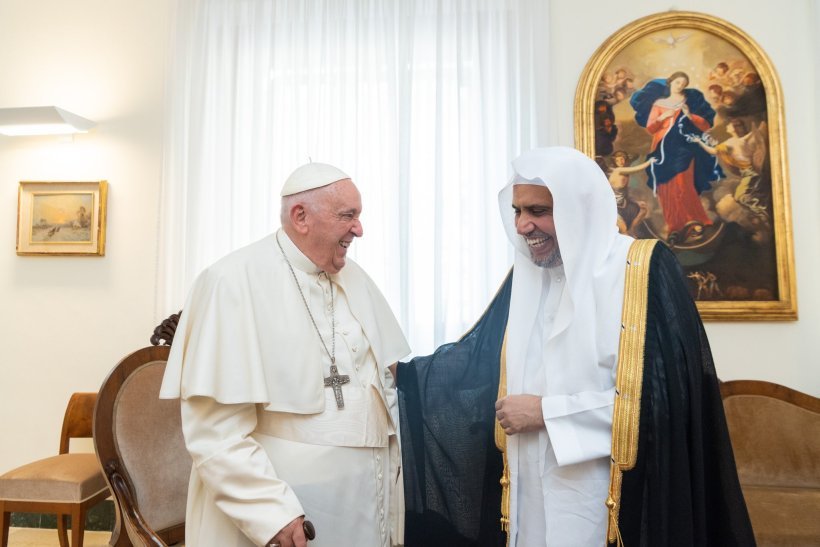
In recognition of his efforts, the prestigious University of Bologna, a historically and academically renowned Italian public university, awarded him an honorary postdoctoral fellowship in law in December 2024. Dr. Al-Issa and Pope Francis, the former head of the Catholic Church, discussed several topics of cooperation and mutual interest during a meeting at the Vatican.
In his remarks on the reasons for being awarded the highest honorary fellowship in law from one of the most prestigious Western universities, Dr. Al-Issa explained that it represents Islamic values that we have a duty to clarify for everyone, stemming from our responsibilities within the Muslim World League, the Muslim Scholars Association, and the Federation of Universities of the Islamic World.
As part of his efforts, he also launched the “Islamic Studies and Arabic Language Award” at a ceremony at the Catholic University of Milan, Italy, in the presence of high-ranking officials, including the Vatican Secretary of State, Cardinal Pietro Parolin, and the university president—partners in the launch.
The model of moderate intellectual and religious discourse, spearheaded by His Excellency Dr. Al-Issa, in building a cumulative discourse for the Muslim World League since 2016, is one of the most prominent and successful examples in the Middle East of creating genuine religious diplomacy. It reflects the true essence of religion in upholding the value of humanity, which God has honored in all His holy books and in the texts of His teachings conveyed by His prophets and messengers to all people from the beginning of creation until the Day of Judgment.
Since 2016, Dr. Al-Issa’s experience has been successful in positively correcting misconceptions about religion in the international collective consciousness. Since assuming the responsibility of the Muslim World League’s secretariat, he has achieved—and continues to achieve—continuous successes in consolidating its presence and rectifying the misrepresentations of religion, highlighting and refuting the abuses and false claims made against it, particularly in its internal relations among its followers and its relations with followers of other religions. This role has laid the foundation for a new diplomacy that can be described as “religious diplomacy,” which had been absent for decades, during which religion was subjected to stagnation, exploitation, and manipulation for ideologies or policies that are far removed from its ultimate purpose.
Dr. Al-Issa’s experience since 2016 has been successful in promoting positive conceptual correction in the international collective consciousness regarding religion. Given the shortcomings of many Western intellectual models and their inability to provide genuine visions for the new international order, we are in dire need of presenting such successful experiences that originated from the heart of our societies and spread to the world.
Over consecutive years, these experiences have been able to build cumulative expertise that undoubtedly represents important principles for enriching the human experience in its entirety. This experience deserves the appreciation it does, and I proudly observed this in joint dialogues with a number of international journalists and media professionals on the sidelines of the tenth United Nations Alliance of Civilizations Forum in Cascais, Portugal. During these dialogues, they raised the idea of the importance of drawing inspiration from the experience of Dr. Mohammed Al-Issa, to serve as a model for successful religious diplomacy around the world.